....in other words, Human measurement.
No
keys. No cards. No passwords. No pin numbers. No forgetting. No mistake.
If your finger doesn't fit, you're not gettin' in!
Built in Time & Attendance and Fire Register - can you afford not
to have these?
Eliminate the requirement
for keys, codes and cards to control door access. The capability of ensuring
the person accessing a door has the authority to do so has traditionally
been via pin-pad or card-swipe. Although effective, does not guarantee
the pin-code or swipe-card has not been stolen. In addition, pin-codes
are forgotten and swipe-cards are misplaced, but with Biometric technology
these variables in your security processes are eliminated.
History of Fingerprinting. The use of fingerprints as means of authentication and identification goes back as far as far as ancient Babylon and China. Since those ancient days the science of identification by means of fingerprints has been developed to the sophisticated methods employed in biometric products today.
Biometric Identification - How does it work?
| A fingerprint is made up of a series of ridges and troughs very much like the ripples that we see when a stone is dropped into water. Each pattern is unique to the finger upon which it sits, in fact the chances of someone having the same fingerprint, as you are 1 in 64 billion. |
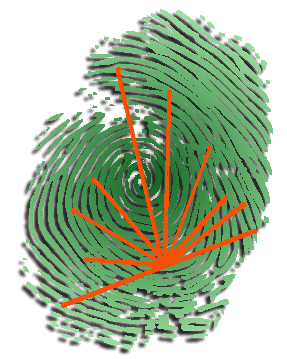 |
However in order to identify someone from their fingerprint it is not necessary to examine the whole print pattern. Fortunately for us the fingerprint also contains other features we call minutiae or small features. These are points where the lines end or divide.
It is the pattern of these small features that most fingerprint locks store and use to validate the user of the lock, and not the whole fingerprint image. When the user presents a fingerprint to the lock, it is the minutiae points that are quickly determined and compared to those stored in the lock memory; if a match is found the lock is opened and if not then access is denied, it's as simple as that.
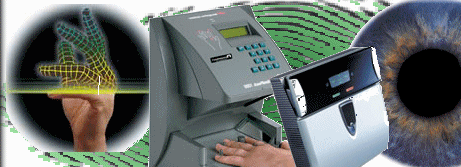
Today the advancements
in technology also mean we can use other parts of the body for unique
access criteria. This includes the whole hand, used in Hand
Geometry readers and Iris Scanners.
Did you know, from the age of two year old, the iris doesn't change
at all?
Just think, no more
forgotten passwords or key numbers, lost cards or resetting of codes if
an employee leaves. Your fingerprint IS the key with biometric technology
fingerprint locks. These amazing products replaces keyed locking mechanisms
with a finger print sensor that actually recognises who is and who is
not authorised to enter.
Adding and deleting users is quick and easy and can be done directly on
the lock or by a PC with appropriate permissions.
From standalone products of one lock to a network of many, have peace
of mind that only the people who need to be there will access specific
areas.
Time and attendance
capability is an in-built feature in some of our models to ensure staff
are recorded in and out, producing a download for payroll systems automatically.
Fire register is another important issue, if you don't know who
is where in your building, how can you be sure everyone is accounted
for in a fire?